
The Flatiron District in Manhattan has been a center of nouveau wellness for around 15 years, with its many boutique fitness classes, gyms, acupuncturists, and stretching and recovery centers. Now, a wave of bathhouses that offer dry heat and cold plunges face off in a few blocks: There is Bathhouse on West 22nd Street, with Othership two blocks away and Altar set to open this winter. You could walk between all three in mere minutes. Williamsburg has its own cluster in Brooklyn, with the original location of Bathhouse, and an Othership that followed.
Welcome to the sauna wars, where dedicated bathhouses compete with members clubs like the West Village’s Continuum (which costs $40,000 per year) that has a bathhouse set up and the Financial District coworking space WSA’s wet lounge as well. The fitness chain TMPL has a whole subway ad campaign entirely around their bathhouse facilities, featuring women in swimsuits reclining in a suggestive way that one doesn’t really find in saunas in real life. (At least, not co-ed ones.)
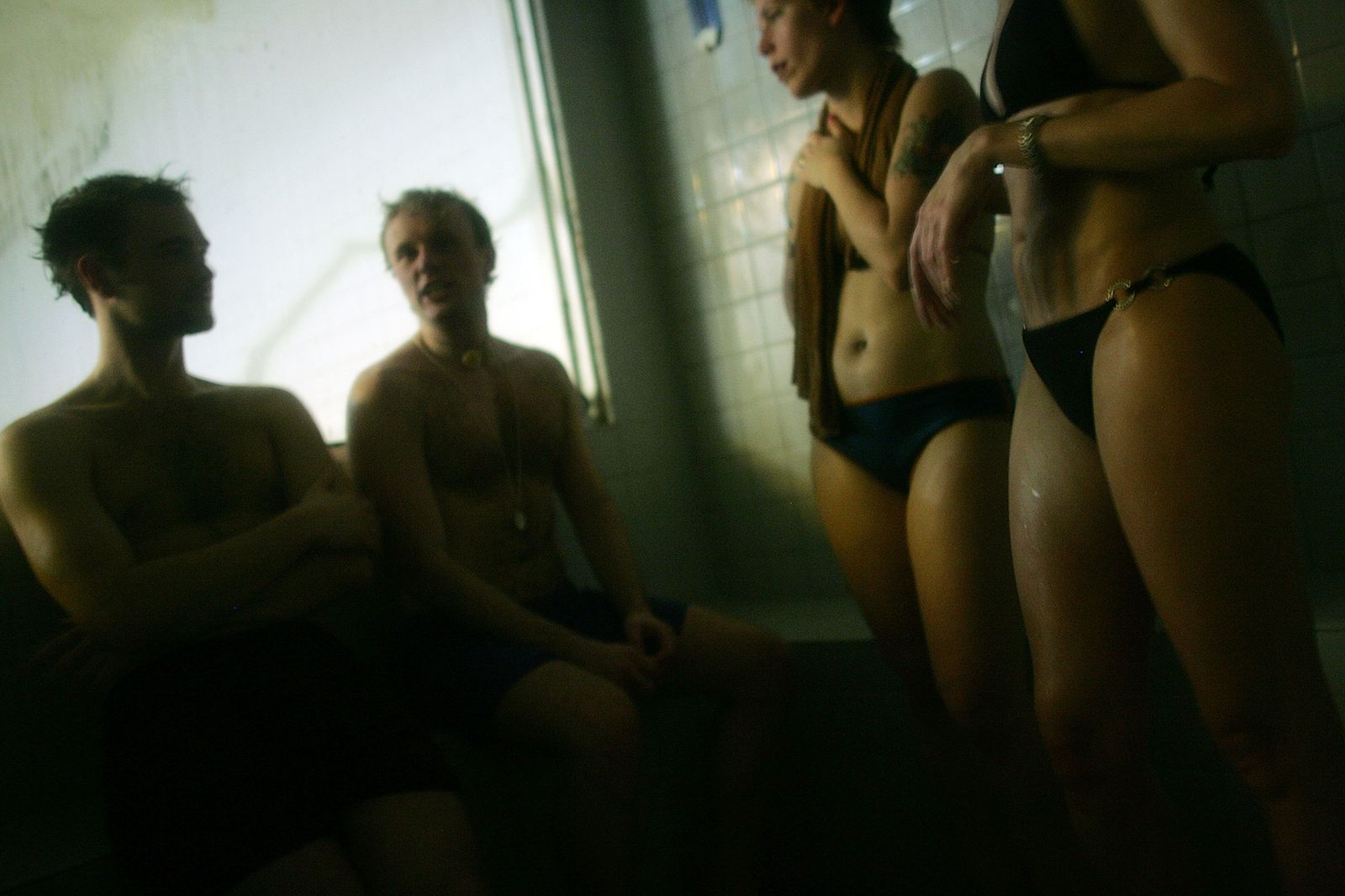
They join stalwarts like the Spa 88 and Aire in Manhattan, Citywell and World Spa in Brooklyn, Spa Castle in Queens, and of course, the Russian and Turkish Baths in the East Village, which is the sort of place newcomers are brought to see a slice of the real New York City. It’s usually teeming with people, some getting wacked by bushels of oak leaves in a treatment called platza, and has two owners, who rotate weeks of ownership. It’s no frills, and even a little gritty. For those who are used to conveniences such as booking ahead, there is none of that to be found. (They do have a nod to modernity with an active TikTok account featuring guest endorsements, recently highlighting Uma Thurman, wrapped in a pashmina and calling it “one of the greatest, best New York institutions.”)
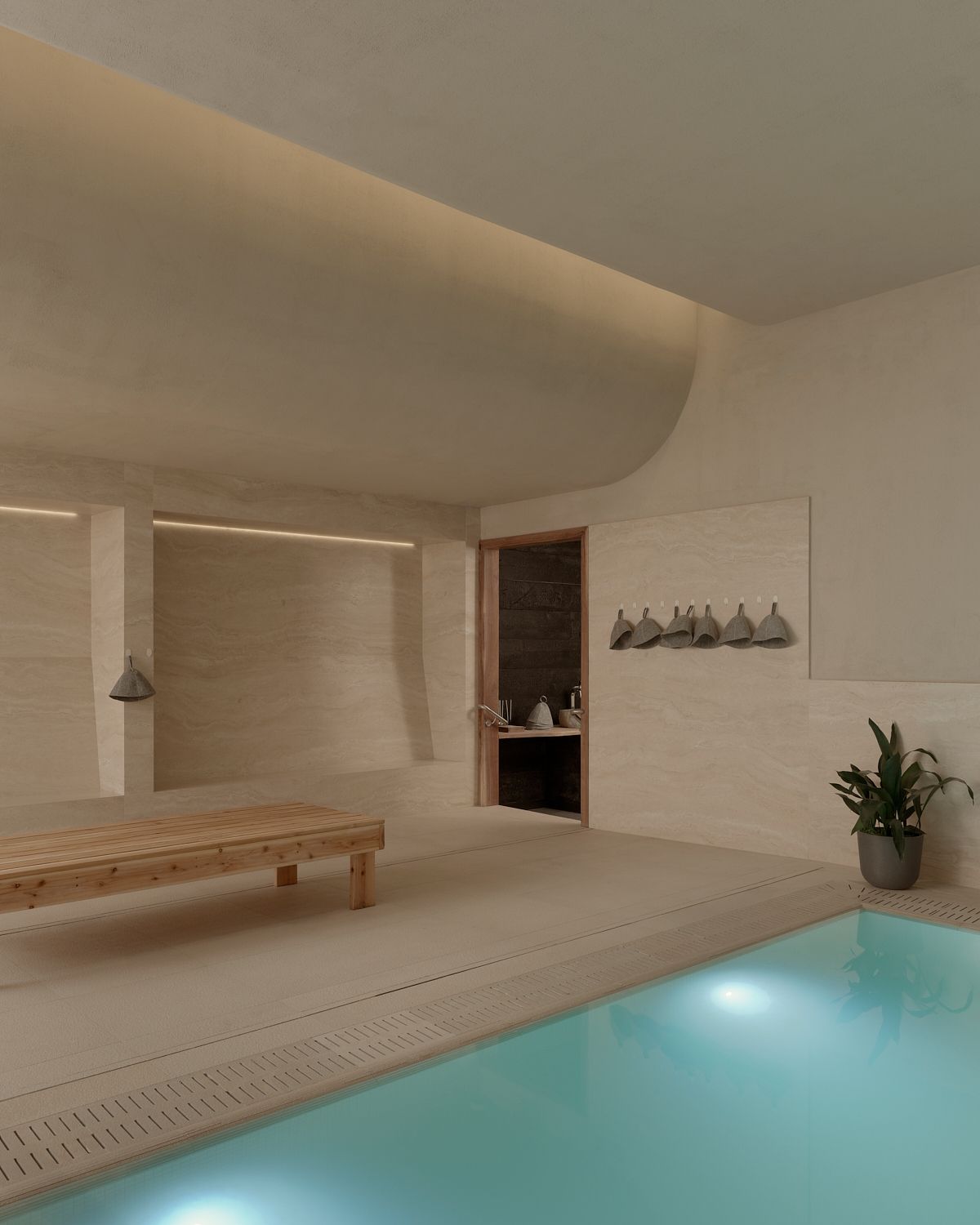
“The first time I went to the 10th Street baths was in 2007. I loved the authenticity and how it made me feel. I would find my way back there when I felt depleted, underslept, whatever it might be. I would come out feeling great,” says James O’Reilly, who was one of the founders of the coworking space NeueHouse. His latest project is the new Lore Bathing Club, founded alongside restaurateur Adam Elzer, Lore takes some inspiration from the Russian and Turkish Baths, as well as the communal sweat traditions of Europe and Asia, and drops it into a 6200-square-foot space finished in travertine and white oak in NoHo.
The bath world is quite a scene, one where skin-care brands such as Pharrell Williams’s Humanrace send out a press release to announce they’re temporarily supplying Lore locker rooms with their signature 7D Gel Sets. Othership is hosting comedy nights. Altar will be selling bathing suits that are custom-made in Brazil—says cofounder Sheba Jafari—and has hired a lighting designer who has worked with Billie Eilish, “so you’re always feeling your best and comfortable and tan,” Jafari says with a laugh while giving a tour of the space. There is already a waitlist of more than 500 people for their membership, which will cost $275 per month paid upfront for $500 worth of credits to be used toward sauna and cold plunge, but also IVs and shots of vitamins, hyperbaric oxygen therapy, red light, NAD+, compression and PEMF. Kohler has an indoor sauna with a list price of $120,200, an outdoor sauna with a list price of $95,500, and even launched a collaboration with the wellness club Remedy Place for an at-home, 39-degree ice bath for $20,500.00.
It is a sauna boom reminiscent of the glut of boutique fitness studios that flooded the market in the wake of the success of SoulCycle. It used to be that you would go to a gym and it was outrageous to go to an expensive group class, says Jafari, “but now there are 99 boutique fitness concepts in a four mile radius.” Still, there are not as many as the peak days pre-pandemic. Not every boutique fitness studio survived, let alone thrived, like Solidcore or Tracy Anderson. (RIP Flywheel.) “Competition is always something we are aware of,” says Emily Bent, Othership’s cofounder and director of marketing. “The saturation in North America for bathhouses is not even close to what it is in Europe. We’re starting an industry. And rising tides and all that.”
While the message from founders blissed out on 180 degree heat is one of bringing together community and good vibes, the reality can be cutthroat. Consider the case of Bathhouse, probably the most well-known of the businesses in the second wave of NYC sauna culture. Cofounders Travis Talmadge and Jason Goodman opened their first location in Williamsburg in 2019 and a second in Flatiron in 2024, both featuring saunas, steam rooms, warm pools, and cold plunges. Goodman saw the company’s more-is-more approach through the model of working on large event production, which he did previously as the founder of the now closed Brooklyn arts center 3rd Ward. “You think like an experience designer,” so going to Bathhouse is not a monolithic experience but more of a “choose your own adventure,” says Goodman.
When it first opened, Bathhouse was jokingly called the Bitcoin bathhouse, as they use the heat generated from mining to warm the tubs. “The comments were like, ‘Oh they’re laundering money through Bitcoin,’” says Talmadge. “But it’s just a fancy pool heater.” Those jabs did not prepare them for what happened earlier this year, when someone posted on Reddit: “I noticed the hot tub and body temp tub were looking kinda dirty and gross. I thought it would be fine, but then I ended up with a UTI.” The poster added that a friend got a UTI at another location.
“A UTI doesn’t walk across the river. If it was a problem it would be a pool at a single location at one given day,” says Talmadge. “There is 24-hour computer monitoring, and they are manually logged five times per day, and we keep the logs. We are adjusting the PH and chlorine at all times. Every drop of water at every pool turns over every 30 minutes. All the vessels have their own independent systems so they don’t mix. The water goes through a sand filter that takes out any particles up to two microns, like a receipt in their pocket or a tag that falls off, or a piece of lint. Then it goes through a UV filter, a big tank with three-foot-long light bulbs of pure UV light that will kill all bacteria and viruses. They’re basically sterile.”
Talmadge and Goodman’s biggest mistake was they didn’t think much of it. “Knowing it wasn’t true, our first reaction was, This isn’t going to go anywhere. Boy, were we wrong,” says Talmadge. What followed was a pile-on, with a former employee alleging on TikTok that Bathhouse had mold issues. (Goodman says it was a photo of a 100-year-old discolored brick wall.) The website Curbed picked up the story in late March, claiming that a former employee shared videos with the publication that seemed to show insects on the floors. The article included a dismissal from Bathhouse.
“The next morning, NY mag put on their Instagram that they got a video of us cleaning our sewer lines,” Talmage says, noting the post was viewed upwards of 3.5 million times. (“We power jet them out and sometimes nasty stuff comes out—we clean out grease traps; we clean the sand filter.”) Various Substacks and YouTubers picked up the story. “It did affect business,” says Talmadge. “The timing was suspect because we were closing a capital raise the day the article hit.”
Goodman says the former employee was someone “who had a big beef with an HR person who had left by then…. It could have been handled better. She had a lot of anger. She ended up sending us a written apology.” (A spokesperson for Bathhouse says the situation was resolved amicably.)
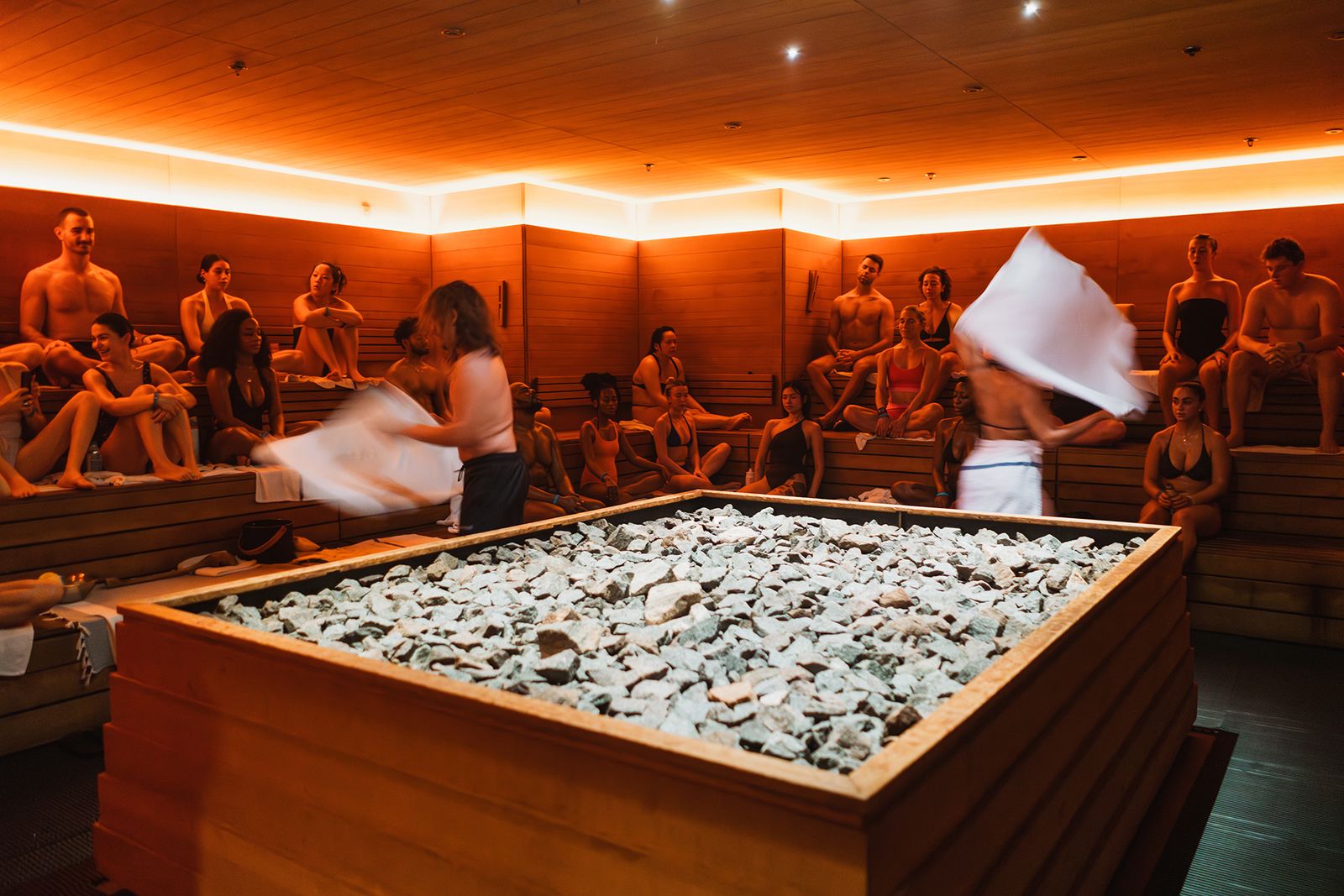
By now things seem normal enough. Talmadge is back to occasionally and anonymously leading aufguss, a German sauna ritual Bathhouse offers hourly that involves a series of snowballs doused in essential oils (one crowded night in November was rosemary and clementine; another chamomile; and the last linseed, vetiver, and spearmint) that melt over hot stones that waft into the air via a towel he twirls around the room spinning it like, well, a helicopter. They’re also expanding across the country, with new locations “in various stages of construction” (and largely funded as built to suit by landlords), including downtown Brooklyn; Philadelphia; suburban New Jersey; Chicago; Nashville; Stamford, CT; Minneapolis; and Hollywood.
“We get the wellness crowd, but also people who work in finance and other high-stress jobs like doctors and lawyers who are burnt out and overwhelmed,” says Bent, who is one of five cofounders of Othership, including her husband Robbie Bent, who was working for the blockchain Ethereum Foundation when they started to think of the concept.
Bent says, “Robbie was navigating some addiction issues with drugs and alcohol his whole life, and he went on an ayahuasca retreat and we met after. We would go to whatever local bath place when we traveled because they were open late, especially being sober. It gives you the sensation of an altered state and dopamine with the hot and the cold and brings you out of your shell.” (Which must be working; they have started to host singles nights and can take credit for at least one engagement from people who met while sauna-ing.)
“It’s super funny to me that the first New York location of Othership is on the same block as Limelight,” says Bill Gifford, author of the forthcoming Hotwired: How the Hidden Power of Heat Makes Us Stronger. He’s referring to the deconsecrated church that housed the storied nightclub of the 1980s and ’90s. Heat, he says, is kind of the same thing but without the drugs. “Heat is good for you. It dilates your blood vessels; it raises your heart rate—similar to exercise, but you don’t have to exercise,” he says. He cites a study from 2015 in Finland, where sauna use is widespread both in public spaces and at home (the word sauna is Finnish). The researchers studied 2,682 middle-aged and older men over a 20-year period, and found that going to a sauna a few times a week led to reduced risks of heart disease, high blood pressure, and sudden cardiac death. “But I don’t think that’s why it’s so popular,” adds Gifford. “People don’t go to lower their blood pressure; they go because it feels good.”
Unlike more freeform hot-cold-hot-cold saunas and cold plunges, Othership is mostly a structured 75-minute experience, with an instructor leading a talk or a meditation or a sound bath for the first 20 minutes. One night involved pairing up with a stranger and looking into their eyes for an unbroken amount of time. Then there is a round of cold plunges, then a return to the sauna where people can stand up and share their experience. It is often men talking about overcoming their resistance to attending and feeling community. Othership is an experience that first-time guests typically either immediately love or vow to never attend again.
Americans readily spend a lot of money on gym memberships or $40 yoga classes. But this country has a fitness culture. And a lot of those gyms have saunas too. Lore is purposefully keeping its membership low, at $225 per month with a $25 surcharge on weekends, to try to get clients into a routine of coming several times a week. Elzer of Lore proposes that Americans see it not as a health expense but rather as something coming from their entertainment budget. It’s like getting a coffee and a pastry, or going for cocktails, he says.
The underlying question is whether any of these businesses will become popular enough to create a real culture of communal sweating in the United States like what you see in Japan or Northern Europe. “What is maybe a wellness or design trend in the US is actually has been embedded in the cultures of these other places for quite a long time and they are not trends—they’re baked into everyday life,” says Kelsey Keith, who is the creative director at MillerKnoll and recently built a sauna for her backyard in Berkeley. She’s not sure it will translate. “People in the US have funny ideas about, you know, nudity and privacy.”


