

Around 10:30 a.m. on a balmy day in late August, New Yorkers in the East Village who had the Citizen app received this notification: “A 911 caller has reported an unconfirmed incident at Avenue B & E 8th St.” Moments later, they were updated: “Police have received a report of a dispute between a man and a woman over shooting a movie.”
Concerned onlookers had seen an attractive couple enter Tompkins Square Park in the midst of an argument. “What am I supposed to do? You’re running away from me,” said the man, wearing red striped shorts and a fanny pack. “You’re a spoiled brat obsessed with your own image,” spat back the woman, wearing a white cable-knit sweater under a blue windbreaker. The man ripped an engagement ring off her finger, storming off before the woman chased him and jumped on his back, almost tackling him to the ground.
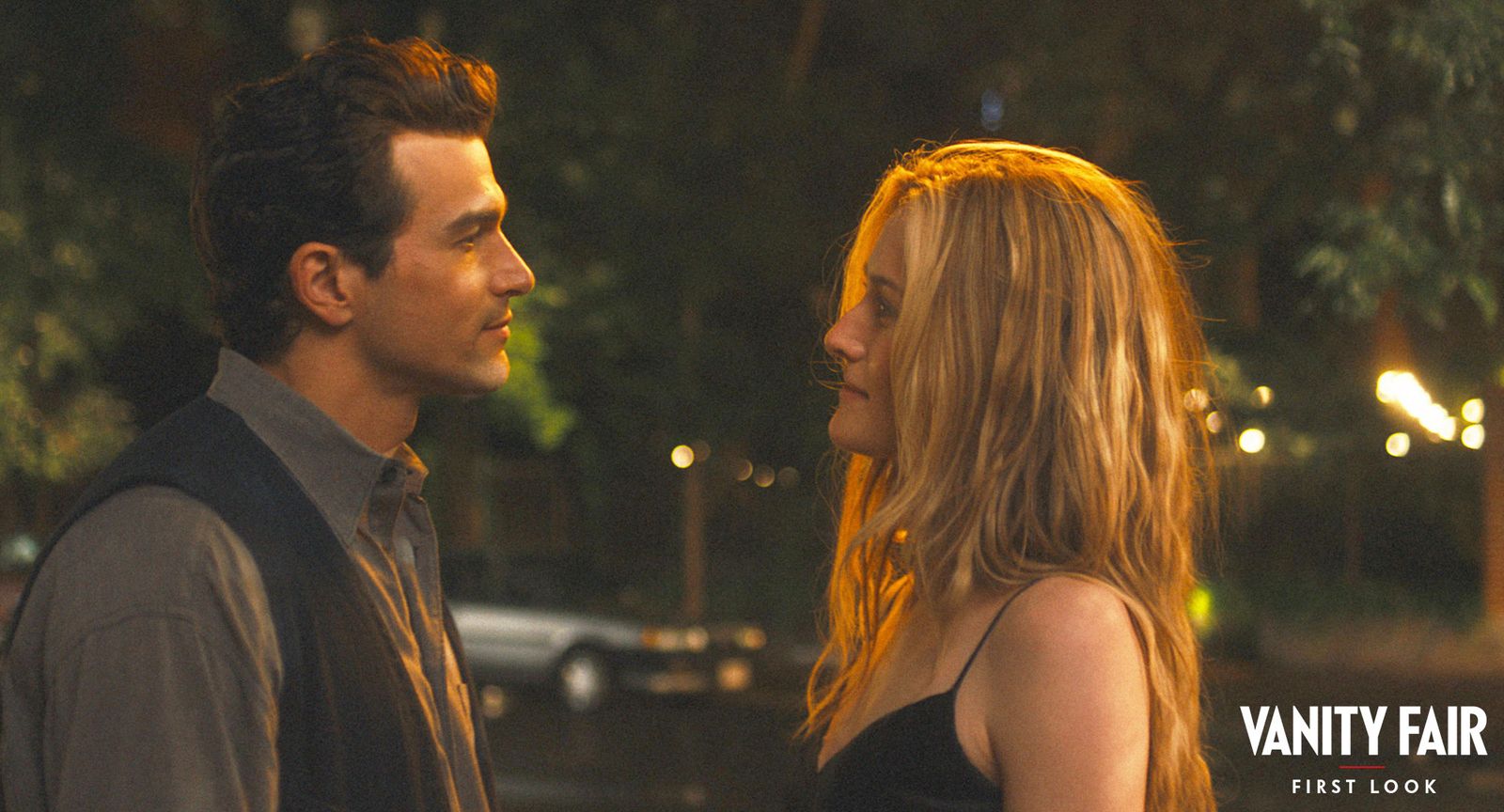
If the citizens had looked a bit more closely, they’d have noticed that this domestic dispute was actually part of a scene being filmed for Ryan Murphy’s highly anticipated series Love Story: John F. Kennedy Jr. and Carolyn Bessette. Love Story, premiering on FX in February, stars newcomers Paul Anthony Kelly and Sarah Pidgeon as the scion of the Kennedy family and the Calvin Klein saleswoman turned PR maven he’d marry. Over the course of nine episodes, Love Story follows their unlikely courtship, whirlwind romance, and untimely demise.
Kelly and Pidgeon were exploring the darker part of Kennedy Jr. and Bessette’s relationship in Tompkins Square Park, recreating a fight from 1996 that was captured in real time by tabloids and covered on the nightly news. In a hyper-meta turn of events, Pidgeon and Kelly were also being watched by photographers snapping the actors in costume as they filmed.
“It’s not lost on me that there are parallels. We’re filming in the same spaces that so many of these paparazzi photos of them were taken,” Pidgeon says. “I’m very aware that I’m making a TV show, [but] knowing that there are similarities in the experiences of being there, and not having a choice over that—it sparks something in your nervous system.”
Murphy’s forthcoming series was originally titled American Love Story, planned as the next installment of his enduring American Story franchise. But nearly 15 years after launching said franchise with American Horror Story, Murphy, alongside Brad Simpson—who has executive-produced American Crime Story, American Sports Story, and Love Story—realized he was ready to go global.
“[We] wanted the show to have international appeal,” Simpson says. “If people like the story and we’re looking for new love stories to do, we don’t want to be confined by just America.”
Despite the name change, Love Story’s first subjects are arguably the most influential American couple of their micro-generation. John F. Kennedy Jr. and Carolyn Bessette defined New York City in the ’90s—turning heads at society events, making the front pages of newspapers and tabloids. But though their relationship looked picture-perfect, the reality was far more complex. It began in the shadows of their lingering respective exes: actor Daryl Hannah and model Michael Bergin. Shortly after Kennedy Jr. and Bessette finally began seriously dating, Kennedy Jr.’s mother—Jackie O, played in the series by Naomi Watts—died of non-Hodgkin’s lymphoma. She never even met her future daughter-in-law. Kennedy Jr. and Bessette’s romance ended in tragedy less than three years into their marriage, when the couple and Bessette’s older sister Lauren died in a plane crash off the coast of Martha’s Vineyard.
Kicking Love Story off with Kennedy Jr. and Bessette was Murphy’s idea, though the series was created by Connor Hines, who serves as an executive producer and wrote six of the nine episodes. “There is no American crown. There isn’t a monarchy here. There’s not that culture,” Simpson explains. Unless, of course, you’re talking about the Kennedys. JFK Jr. “came the closest that we ever had to an American prince. We all saw him grow up. We saw him lose his father. We saw him go to college, go to law school. He had the same obsessive following that the princes in England did.” And who could resist telling the story of how America’s prince found his Cinderella?
Bessette wasn’t exactly toiling in obscurity before she met her Prince Charming; she grew up in Greenwich, Connecticut, after all. But through her own tenacity, talent, and, yes, effortless beauty—she was voted “Ultimate Beautiful Person” in high school—Bessette created a glamorous life for herself in New York. “She was somebody who had been a shopgirl in Boston, who’d risen her way up to the corporate suite at Calvin Klein and was living a ’90s New York female dream,” Simpson says. When Bessette met Kennedy Jr., her profile rose to heights for which she was not, perhaps, prepared. “It was dynamic and incredible,” Simpson says of the pair’s meeting. “They quickly became the most famous couple in America.”
Rather than looking to established stars to play Kennedy Jr. and Bessette, Simpson and Murphy sought to cast relative unknowns. Simpson had been “blown away” by Pidgeon’s Tony-nominated performance in the Broadway hit Stereophonic. “We had one day of reading Carolyns, and she got the job.”
Finding the right person to play Kennedy Jr. proved far trickier. “John had a very specific look that is old-school-movie-star handsome. We’re talking early Richard Gere,” Simpson says. “He was a broad-shouldered, masculine guy, a man who had hair on his chest.” They had some 3,000 people read for the role. “Anybody who was between the ages of, let’s say, 29 and 39.” Still, they kept coming up empty.
As it got dangerously close to the start of production, Murphy instructed Simpson and the casting team to go back into the “slush pile” of contenders and see whom they might have overlooked. They ultimately found three people to look at more closely, having them do an old-fashioned screen test opposite Pidgeon in New York, complete with cameras and makeup. There, a Canadian model turned actor, who’d flown in from Portland, Oregon, won over the room. “We sat there, and crew members kept coming up to me going, ‘You have to cast this guy,’ over and over,” Simpson says. “‘Please make it this guy.’” And just like that, Paul Anthony Kelly clinched the part.
“I walked into the chemistry read, and it was myself and several other gentlemen also reading for the role. But there was something about Sarah,” Kelly says. “We had chemistry, obviously, but there was an unspoken sense of support for each other. Like, ‘Okay, I’m here for you.’” Pidgeon felt it too. “We both went to the airport right after the final screen test, and I just remember the beautiful messages you sent me, like, ‘I’m so ready to do this. I’m ready to jump in,’” she tells Kelly. “It was so reassuring to hear from a stranger this genuine willingness to support each other—this understanding, I think immediately, that this is something that we were doing together.”
.jpg)
The name change and the casting scramble weren’t the only hurdles Love Story faced. As production began, Murphy released test shots of Kelly and Pidgeon as Kennedy Jr. and Bessette online. Members of Gen X will remember that Bessette was your fashion friend’s favorite fashion girl in the ’90s, a trendsetter whose neutral, tailored style raised the profiles of brands like Yohji Yamamoto and Miu Miu. The pressure was on for Love Story to nail her iconic look.
Yet the initial reaction was…less than ideal. Critics rushed to drag the photos, saying that Bessette’s wardrobe looked “off the rack” and like “fast fashion”—sacrilegious words to use when describing a style icon. Then the paparazzi caught wind of the production, with shots of Pidgeon shooting scenes as Bessette flooding tabloids like Just Jared. As one Reddit user wrote in response to some Just Jared images, “She looks cheap and doesn’t give Carolyn at all. I’m sick.” In those same photos, Pidgeon wore Converse sneakers—something diehards claimed the real Bessette would absolutely never wear.
It wasn’t just the clothing. Apparently, Pidgeon was carrying the wrong Birkin bag—No. 35, not Bessette’s signature, No. 40. Brad Johns, Bessette’s former hair colorist, noted that Pidgeon’s hair was too ashy and one-note, lacking the buttery chunks that became Bessette’s hallmark. “No one would believe that Carolyn in the ’90s would ever have that color from me,” he told Vogue. “It’s too 2024.”
“I want to love this, but so much is missing the mark in the wardrobe department,” New York stylist Liz Teich commented on Instagram. “THE WARDROBE IS A MAIN CHARACTER IN THIS STORY…. Please step it up in production.” In short, it was wrong. All wrong.
Murphy eventually responded to the backlash, clarifying that the test shots were just that—test shots—and not the final product. “There were comments like, ‘I hate that coat, Carolyn would never have worn that,’” Murphy told Variety. “That was just a coat we threw on for color.”
“Ryan released some early photos. The world talked back,” Simpson says of the costume kerfuffle. “We were already making adjustments, but we made further adjustments. We wanted to get it right, and we endeavored to get it right on the show.”
Murphy and Simpson assembled a group of 10 consultants, including Bessette biographer Elizabeth Beller, to help fix Bessette’s look. After filming began, the production also let go of the show’s original costume designer—Murphy’s Feud: Capote vs. the Swans collaborator Leah Katznelson—and hired Rudy Mance, who began his career as a Condé Nast fashion assistant and eventually became a costume designer on multiple Murphy productions, including Pose and Doctor Odyssey.
“I got the call. I hopped on a plane less than 24 hours later,” Mance says. “Normally, you spend weeks and weeks referencing and prepping and wrapping your head around it. But on this one, I think we had about four days—while they shut down over July Fourth weekend—to reshop, refit, and redesign.” Once production was up and running again, Mance says, there were “quite a few reshoots” with his new designs.
Despite the time crunch, a quick tour of Love Story’s sun-drenched costume closet in Greenpoint reveals that Mance was the right man for the job. The walk-through closet houses a mix of fashion sourced from around the globe via Etsy, eBay, and Instagram, as well as items rented from costume houses, garments created specifically for the series, and pieces true to what Bessette actually owned. “We found a collector out of Canada who had, I think, 30 or 31 original pieces. I don’t think that they could authenticate that they were actual pieces that she herself had worn, but they were exact pieces from that time period and from the collector,” Mance says. The originals included “a lot of the Yohji pieces that she had worn, the Valentino coat, the Prada boots.” They also found the right Birkin bag in the end.
While Mance and his team of about 40 wardrobe assistants and designers made the necessary adjustments, he has compassion for his predecessor. It’s extraordinarily difficult to re-create Bessette’s impeccable wardrobe, especially the pieces she wore at the beginning of her relationship with Kennedy Jr. in the early ’90s. “Everybody knows what they wore from 1996 to 1999, but we were telling the story of how they met,” Mance points out. And while there are public archival images of Kennedy Jr. that span his entire life, that’s not the case when it comes to Bessette. “The most challenging thing was how to tell the story in terms of the clothes, who she was before she was photographed relentlessly.”
For what it’s worth, Pidgeon was unperturbed by the initial response to the test shots—“It wasn’t a huge shock that people had feedback about it,” she says—and even enjoyed dyeing her hair blond. “It’s really nice, because five days out of the week, it’s styled, so I look really good,” she says. “And then on the weekends, I look…not as good.”
Re-creating the ’90s went beyond the costuming and grooming. “We are using Calvin Klein’s design aesthetic as the overall blanket over the whole look for the show,” production designer Alex DiGerlando says. “That ’90s minimalist chic that’s defining that era.” And there were other ’90s influences beyond the central couple: “We definitely leaned into a more American Psycho vibe.”
But ultimately, the clothes make the man—or, in this case, the woman. “They’ve been fashion icons since the first photograph, especially her,” Mance says. “It was important for all of us to get it right and to just be respectful of them and their legacy.”
Even in 2026, diving into the Kennedy family—known as much for its glittering successes as its many tragedies—is fraught, to say the least. Robert F. Kennedy Jr., the cousin of John F. Kennedy Jr., is changing vaccine recommendations and telling Americans to eat more red meat as President Donald Trump’s controversial choice to lead the Department of Health and Human Services. Jack Schlossberg, John’s nephew, has both announced a bid for Congress and expressed his displeasure at Murphy for making a show based on his family. At the end of last year, his sister Tatiana Schlossberg, an environmental journalist, tragically died at 35 after being diagnosed with acute myeloid leukemia.
When making shows like Love Story and American Crime Story, “we were really cognizant that we’re making TV shows about real people—that there’s family members, there’s loved ones,” Simpson says. “We’re trying to be empathetic to all of our characters. This is a very sincere show. This is a show that is on the side of these characters, and our hope is that we don’t cause hurt in the world.”
Ultimately, Simpson and his team are proud of how they’ve depicted one of America’s most prominent families. The Kennedys are “legendary within culture,” Kelly says. “I’m just so focused on bringing integrity and truth to the story as I know it.” Pidgeon agrees, and had the added challenge of trying to capture the ethos of an eventual Kennedy who, despite being constantly photographed, remained an enigma most of her life. While there’s a plethora of footage of John, only 18 seconds of recorded footage of Bessette speaking is available for public consumption.
Pidgeon admits to feeling a certain kind of pressure, “the pressure of really understanding who Carolyn is and wanting to do her justice and get her right,” she says. “Of course, every single time you leave a film set, it’s like, Damn, that’s how I was supposed to do it.” But watching Pidgeon shoot that Tompkins Square Park scene, shouting and eventually reconciling with Kelly’s John, makes it clear she has nothing to worry about. As the episode’s director, Crystle Roberson Dorsey, says in between takes: “They look really good together.”
More Great Stories From Vanity Fair
Cover Star Teyana Taylor on Her Breakout Year
I Was Held Hostage in Panama in 1989. I Know the Real Cost of Trump’s “America First.”
The Roommate Scandal That Has Downtown New York Talking
Autopsy Report: Inside the Murdoch Dynasty’s Final Moments
The 11 Best-Dressed Stars at the 2026 Golden Globes
The MAGA Dive Bar That’s Also a Church
The Life—and Shocking Murder—of Playboy Playmate Dorothy Stratten
Belle Burden On Her Family’s “Legacy of Infidelity”
Susie Wiles, JD Vance, and the “Junkyard Dogs”: The White House Chief of Staff On Trump’s Second Term
From the Archive: Hitler’s Doomed Angel


